Subagents Are Context Compression Functions, Not Team Members
Why domain-based multi-agent architectures fail and what to do instead
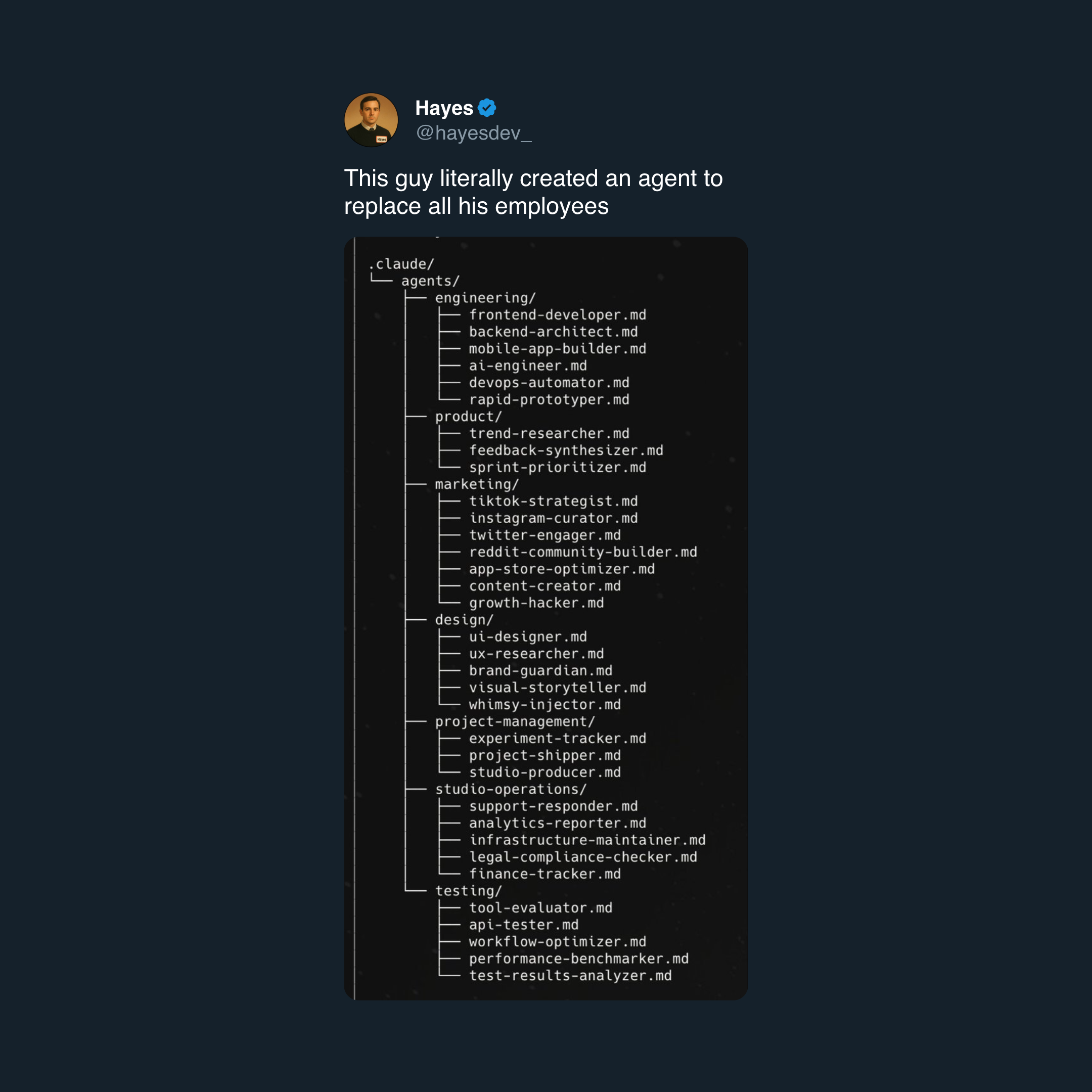
Most multi-agent architectures are org charts wearing code.
You've seen them: frontend-developer, backend-architect, mobile-app-builder. Agents with job titles. This feels intuitive because it maps to human teams, and intuition is exactly why it fails.
By the time context reaches a specialized subagent, previous decisions have been lost. Cognition's analysis demonstrates this with Flappy Bird: separate frontend and backend agents produce mismatched aesthetics and broken assumptions. Research on 200+ multi-agent traces found 36.9% of failures stem from inter-agent misalignment. Information silos kill coordination.
The correct mental model: subagents are context compression functions.
Not colleagues. Not specialists. Compression functions. They consume thousands of tokens exploring a problem space and return a condensed summary. That's it. That's the entire value proposition.
The Org Chart Anti-Pattern
Here's a real example of what not to build:
HumanLayer Got This Right
When building the deepagent sdk, I spent weeks studying how people structure specialized agents.
HumanLayer has one of the best examples. They talked about it at AIE and open sourced it here.
codebase-locator: Finds WHERE code lives (not what it does)codebase-analyzer: Understands HOW code workscodebase-pattern-finder: Identifies existing patternsweb-search-researcher: Conducts web research with structured output
Notice the scoping. Each agent has one job and explicit output format. Notice what they explicitly forbid:
DO NOT suggest improvements or changes unless the user explicitly asks
DO NOT perform root cause analysis unless explicitly asked
DO NOT propose future enhancements unless explicitly asked
DO NOT critique the implementation or identify problems
Each subagent is a documentarian, not a critic. It returns structured findings. No opinions. No speculation. Predictable, parseable output.
Their research_codebase command demonstrates the pattern at scale: spawn parallel subagents for exploration, let each explore independently, synthesize findings into a single document. MapReduce for context.
I've been testing these patterns exclusively to build the deepagent sdk. They work. Source.
Subagents as MapReduce
Phil Schmid describes the pattern: treat agents as tools. The main agent invokes call_planner(goal="..."), a harness spins up a temporary sub-agent loop, and returns a structured result.
Anthropic's context engineering guide adds specificity: subagents explore using tens of thousands of tokens but return condensed 1,000-2,000 token summaries. Context stays isolated. The parent receives distilled insight, not exploration traces.
Use subagents when detail doesn't matter, only outcome matters.
Here's the pattern in deepagent sdk:
import { createDeepAgent } from 'ai-sdk-deepagent';
import { anthropic } from '@ai-sdk/anthropic';

const researchAgent = {
  name: 'research-agent',
  description: 'Deep research with condensed output',
  systemPrompt: `Execute thorough research using available tools.

    Output format (required):
    {
      "findings": "2-3 sentence summary",
      "key_points": ["point1", "point2", "point3"],
      "sources": ["url1", "url2"]
    }

    Do NOT include search queries, intermediate reasoning, or tool call history.`,
  model: anthropic('claude-haiku-4-5-20251001'),
};

const agent = createDeepAgent({
  model: anthropic('claude-sonnet-4-5-20250929'),
  systemPrompt: `You coordinate complex tasks. Delegate research to research-agent.
    It returns structured findings. Use those findings to complete your task.`,
  subagents: [researchAgent],
});
The key: explicit input and output contracts. The subagent is a pure function: research(topic) → {findings, key_points, sources}. No side effects. No context leakage. Predictable compression.
Don't Use Subagents for Repeatable Tasks
Here's where most teams go wrong. They build a typescript-expert subagent or a react-specialist agent to handle domain-specific work. This wastes context and adds latency for tasks that should be repeatable.
Repeatable tasks belong in Skills. A Skill packages domain knowledge, workflows, scripts, and assets into a reusable module. Need to rotate a PDF? The skill includes scripts/rotate_pdf.py. Need to write unit tests? The skill includes your testing standards. The agent loads the skill, runs the bundled scripts, produces consistent output. Every time. No context isolation overhead.
Use subagents when you need what skills can't provide:
Context isolation. A research-assistant subagent can explore dozens of files without cluttering the main conversation. It returns only the relevant findings. Anthropic's SDK documentation calls this out: "preventing information overload and keeping interactions focused."
Parallelisation. Multiple subagents run concurrently. During a code review, spawn style-checker, security-scanner, and test-coverage subagents simultaneously. Minutes become seconds.
Tool restrictions. Subagents can be limited to specific tools. A doc-reviewer subagent might only have Read and Grep access, ensuring it can analyse but never modify.
| Scenario | Skill | Subagent |
|---|---|---|
| Rotate a PDF | ✅ Bundled script | ❌ Overkill |
| Write unit tests | ✅ Standards loaded | ❌ Single-file task |
| Security audit | ❌ Can't parallelise | ✅ Concurrent scanners |
| Codebase exploration | ❌ Would pollute context | ✅ Isolated findings |
| Multi-file refactor | ❌ Can't coordinate | ✅ Systematic analysis |
Stop Building Org Charts
Stop thinking: "This subagent specializes in frontend work"
Start thinking: "This subagent compresses codebase exploration into structured summaries"
Design subagents around information transformation, not domain expertise. Define explicit contracts: input schemas, output formats, token budgets. Monitor compression ratios. If a subagent returns more than it summarizes, delete it.
Phil Schmid puts it simply: "Don't over-anthropomorphize your agents. You don't need an 'Org Chart' of agents (Manager, Designer, Coder) that chat with each other."
Build compression pipelines. Not teams.
References:
- Cognition: Don't Build Multi-Agents
- Anthropic: Context Engineering for AI Agents
- Anthropic: Subagents in the SDK
- Anthropic: Agent Skills Overview
- Phil Schmid: Context Engineering Part 2
- LangChain: Deep Agents
- HumanLayer: Claude Code Agent Examples
- PRPM: When to Use a Claude Skill vs a Claude Sub-Agent